
An imaging architecture determines how the scene is sampled and what information is available for inspection. Part motion influences acquisition, while the feature determines whether intensity, color, or depth is useful. Lighting feasibility belongs in this initial assessment because the material’s response can change the wavelength, viewing direction, or number of images required.
Area and line acquisition
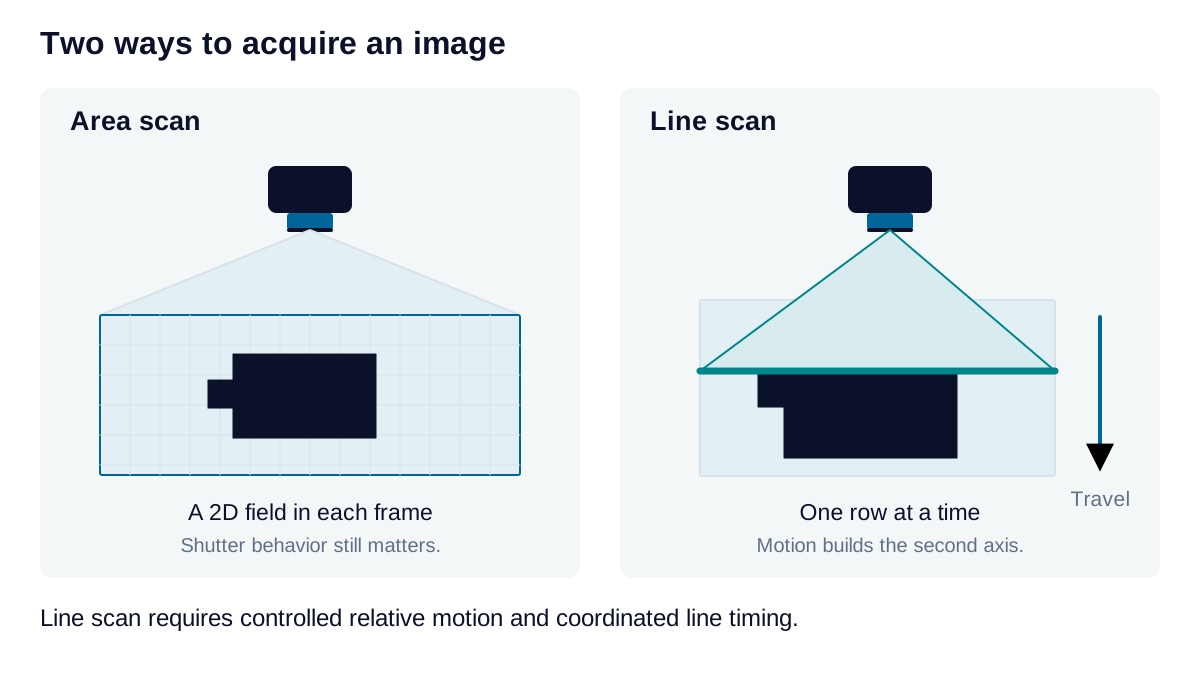
An area-scan camera records a rectangular pixel array in each frame. This arrangement provides a defined view of an individual part or scene. Moving parts can be imaged when exposure duration and triggering are compatible with their motion.
A line-scan camera records successive lines as the object or camera moves. This provides continuous coverage of webs, rotating surfaces, and long products. The spacing between lines depends on relative motion and acquisition timing, so transport behavior affects the reconstructed image.
Intensity and depth information
Acquisition mode and dimensional information are separate choices. A 2D image represents brightness or color and can reveal outlines, texture, and material differences. A height map, often described as 2.5D, records a single height at each lateral sample. A more complete 3D surface representation may combine measurements from several views through registration. Surfaces hidden from the necessary viewing or illumination directions remain unmeasured.
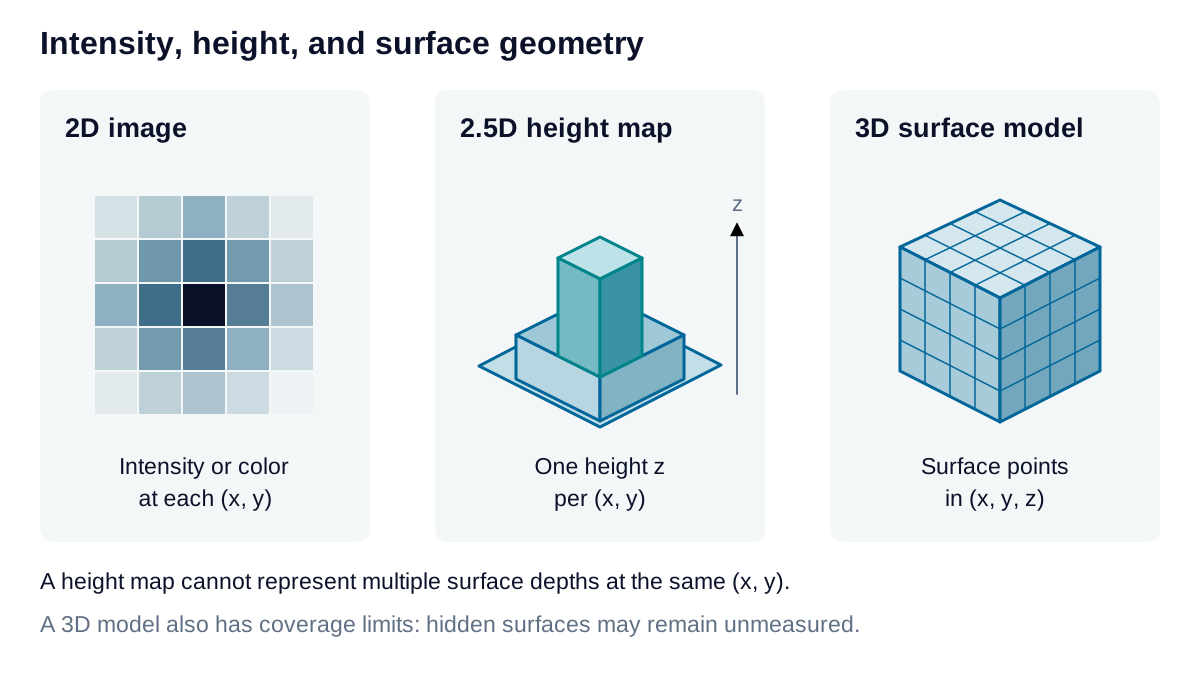
Depth sensing is appropriate when the required height, profile, or pose cannot be recovered reliably from 2D evidence. Method selection depends on surface reflectivity, occlusion, motion, field of view, and required accuracy. Lateral sampling and depth performance need separate specifications.
Line rate and motion
For constant relative motion perpendicular to the sensor line:
Here, is relative object speed in mm/s, is line spacing in mm, and is the acquisition rate in lines/s. A speed of 1,000 mm/s with 0.05 mm spacing requires 20,000 lines/s. Sampling across the line is set by the lens and sensor.
Encoder-based triggering can maintain line spacing as speed changes. The resulting rate must remain compatible with exposure, available light, readout, and sustained transfer. Uneven spacing stretches or compresses the image along the motion axis.
Spectral response and placement
Monochrome, color, and spectral imaging distinguish different aspects of the returned light. Color is useful when color differences carry inspection information, with corresponding sampling and calibration requirements. Camera placement is another independent choice: fixed and robot-mounted cameras can both support robot guidance with appropriate calibration.
A trial acquisition establishes whether the selected arrangement preserves the feature across expected part variation before detailed component specification.